Marchants' Barrio
It was customarily called that. Barrio means region or area. Since "merchant" alone would be a general noun, scholars at the time added barrio to treat it as a proper noun.
Analysis of the body remains suggests that the man was from the northern Gulf Coast and the eastern Maya region, while the woman was from Teotihuacan. Pottery flakes produced in the Maya region were found, suggesting that women were responsible for spinning.
There is a floor plas available online. The double red circles are also the foundations of the building.
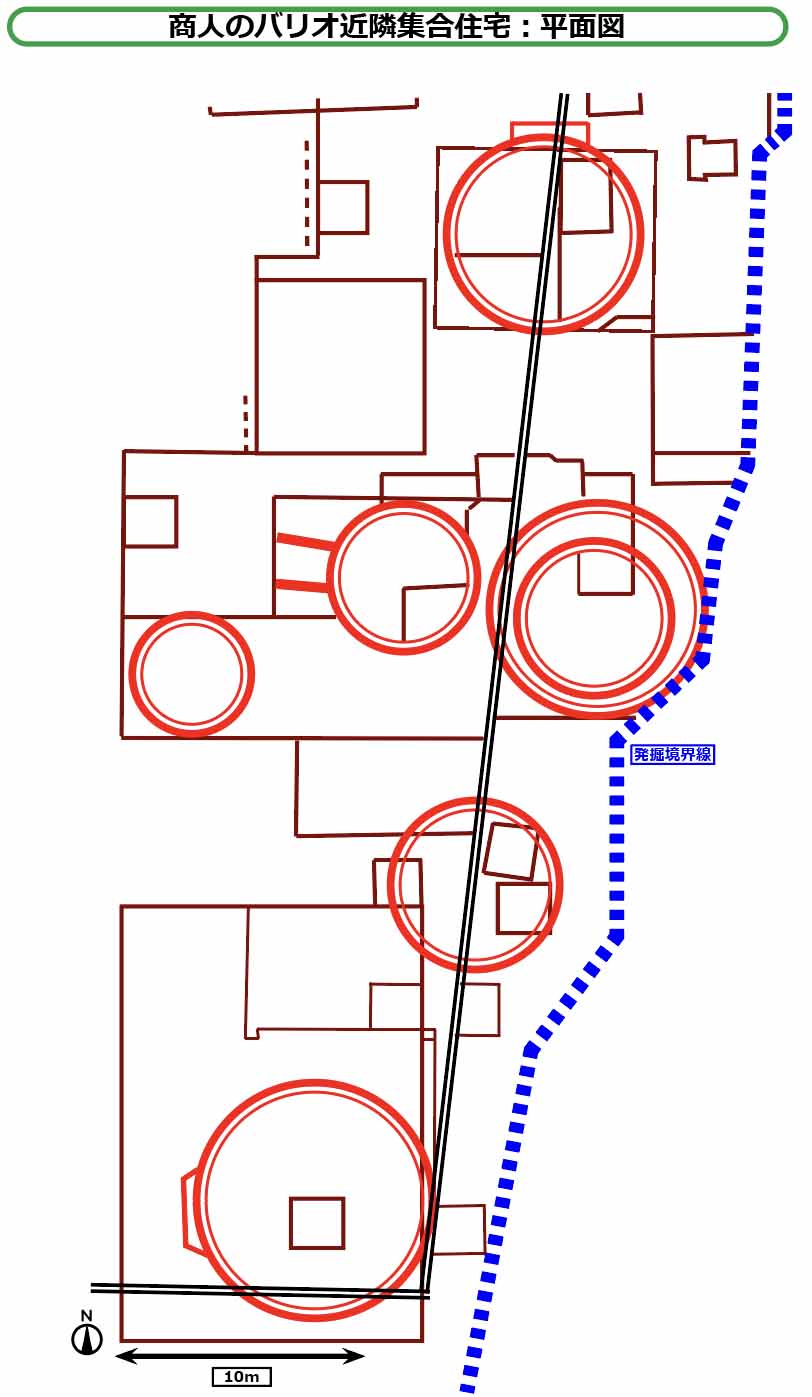
Hmm, how should we read this?
1. The excavation boundary line appears to be on the east side, but what about the other directions?
2. Most of the lines appear to be traces of wall foundations.
3. The straight brown wall is the oldest, and it appears that the red circular house was built in the next period.
4. Finally, a thick double black line connects the east and south sides, which could be a rectangular outer wall. The angle is 7 degrees on the east side and 1 degree on the south side, so they are not perpendicular and are tilted.
The architectural axis of the foundation traces, shown as a straight line, is 0 degrees. The entrance to the circular foundation is also 0 degrees. No other similar architectural axes have been found at Teotihuacan.
The combination of marriage/cohabitation between male outsiders and Teotihuacan women, circular houses, and Maya pottery is intriguing, but the site has been reclaimed and unfortunately no detailed reports have been found.